
EYFS Outcomes
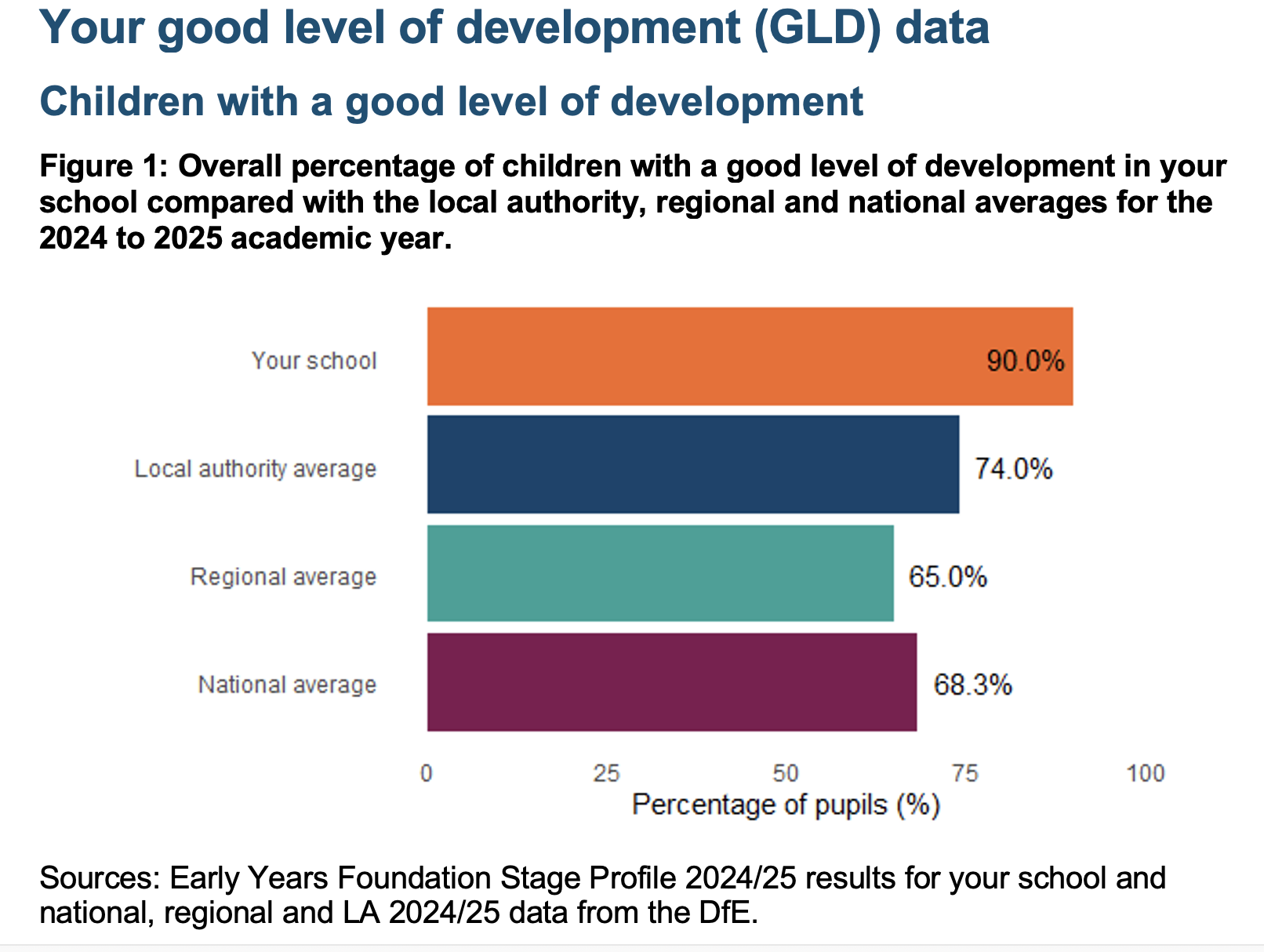
A Good Level of Development (GLD) is a national measure used at the end of the Early Years Foundation Stage (EYFS) to assess how well children are progressing in their learning and development. Children achieve a GLD when they meet the expected level in the prime areas of learning — communication and language, physical development, and personal, social and emotional development — as well as in literacy and mathematics. GLD is an important indicator because it reflects children’s readiness for the next stage of learning as they move into Key Stage 1.
The contextual information for our school demonstrates a cohort with a distinctive profile when compared with local, regional and national averages. The school has a significantly higher proportion of pupils from Asian / Asian British backgrounds (35.6%) compared with local (22.3%), regional (13.9%) and national figures (13.7%). The percentage of pupils from mixed or multiple ethnic groups is also above all comparison groups at 12.2%. In contrast, the proportion of Black / African / Caribbean / Black British pupils is lower than local, regional and national averages.
The data also highlights that the school serves a comparatively less disadvantaged cohort overall. The percentage of pupils eligible for Free School Meals (FSM) is notably lower at 2.5%, compared with 17.1% locally, 28.3% regionally and 25.3% nationally. Similarly, levels of SEND support (8.9%) and Education, Health and Care Plans (2.1%) are below local, regional and national averages. Cohort mobility is extremely low at 0%, indicating a stable intake across the academic year.
Children enter the Reception year with an average age of 4 years and 6 months, and the school’s contextual indicators, including the low IDACI score and urban score, suggest relatively low levels of deprivation within the cohort. The ELG variation score of 3.9 indicates some variation in outcomes across areas of learning, which is typical within early years cohorts.
Overall, these contextual factors provide important background information when considering the school’s Good Level of Development outcomes. The data suggests that the school benefits from a stable cohort with lower-than-average disadvantage and SEND indicators, while also reflecting the rich cultural diversity of its community.