Mobile Phones and Personal Devices at Park Road Academy Primary School
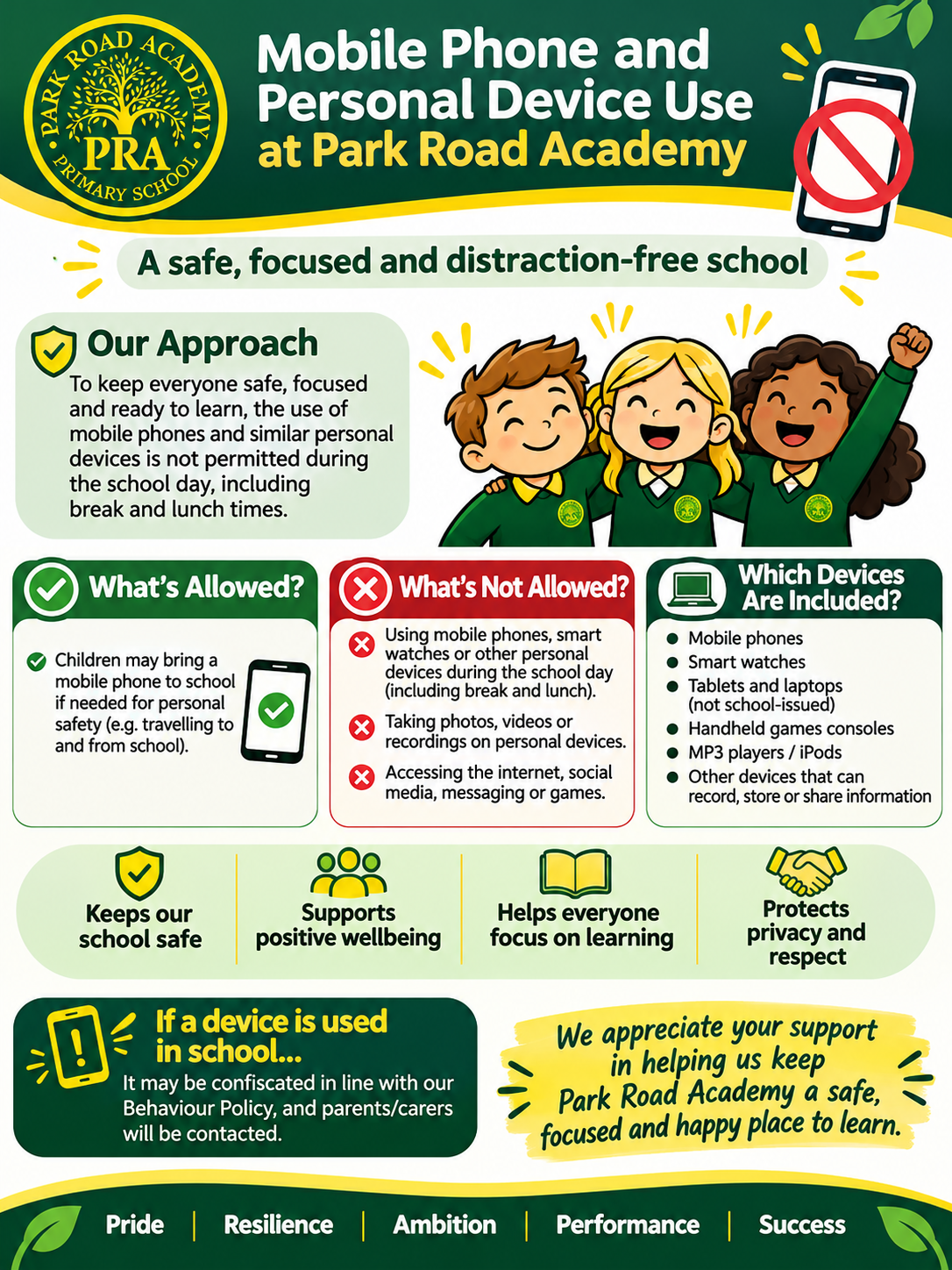
At Park Road Academy, we are committed to providing a safe, positive and distraction-free learning environment where children can focus on their education, friendships and personal development. In line with our Mobile Devices Policy, the use of mobile phones, smartwatches and other personal electronic devices is prohibited throughout the school day, including breaktimes and lunchtimes.
We recognise that some parents and carers may wish their child to carry a mobile phone for safety reasons when travelling to and from school. Where this is the case, mobile phones must be switched off and handed in at the beginning of the school day, where they will be stored securely until collection. Devices must not be seen, heard or accessed during the school day.
We recognise that some children may require access to a device for medical reasons, additional needs or exceptional personal circumstances, and appropriate reasonable adjustments will always be considered and agreed on an individual basis.
If a child needs to contact home during the school day, this will be arranged through the school office rather than through their personal device. Any breaches of our policy will be addressed in line with our Behaviour Policy. By working together with parents and carers, we aim to protect children's wellbeing, reduce distractions, promote positive social interactions and ensure that school remains a place where children can learn, play and thrive.
Our full Mobile Devices Policy is available to read on our school website.
WhatsApp Groups – School's Position
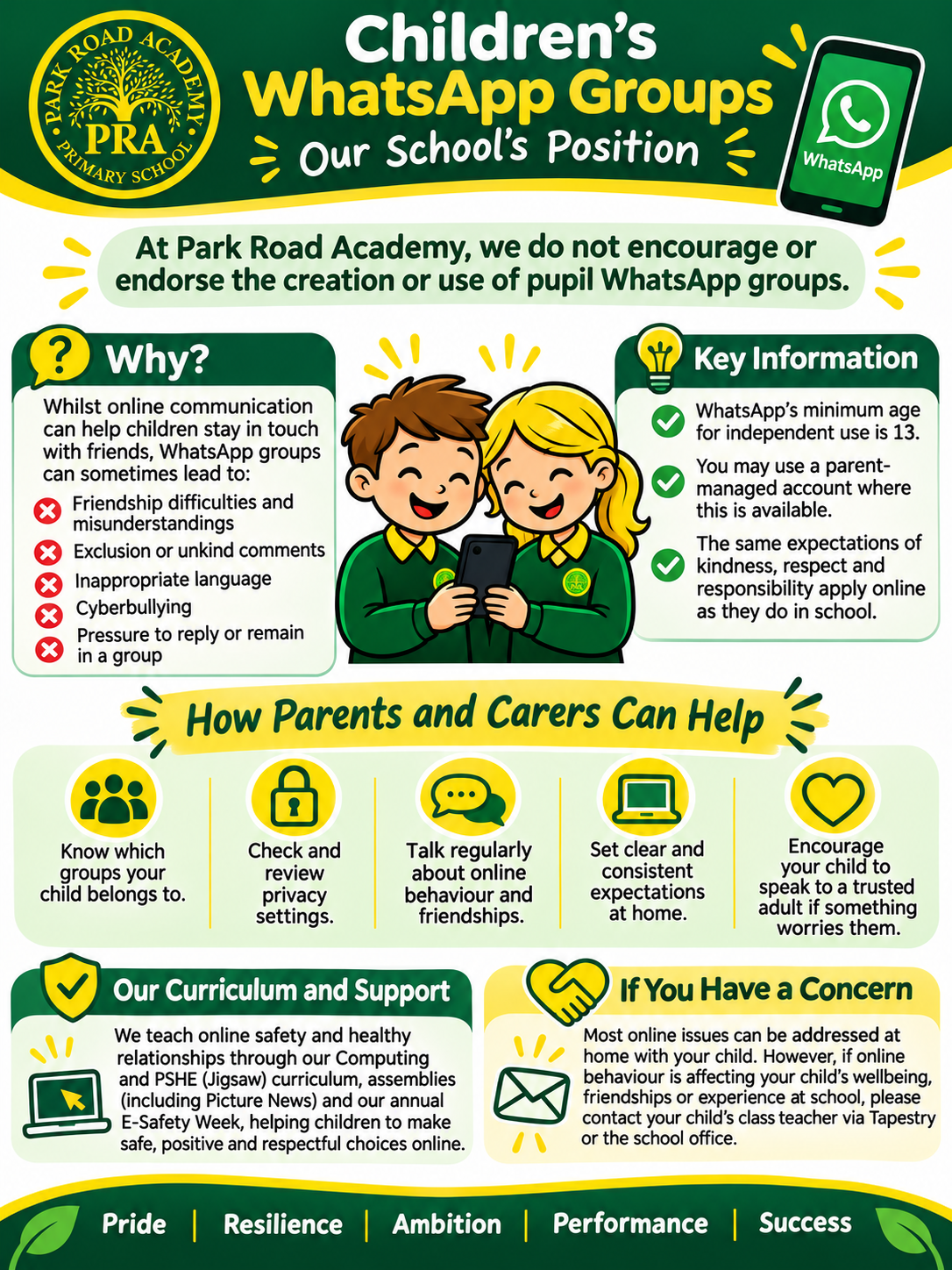
At Park Road Academy, we recognise that children increasingly use technology to communicate with friends outside school. Whilst online communication can offer opportunities to maintain friendships and feel connected, we are also aware of the challenges that group messaging platforms, particularly WhatsApp, can present for primary-aged children.
Our position is clear: we do not encourage or endorse the creation or use of pupil WhatsApp groups. WhatsApp's standard minimum age for independent use is 13, meaning that children of primary school age should not be independently registering for or using the platform. WhatsApp's terms also provide for parent-managed accounts for younger children where this feature is available. We strongly encourage parents and carers to consider age restrictions, their child's maturity and the potential risks before allowing access to messaging platforms.
We know that WhatsApp groups can sometimes become a source of friendship difficulties, misunderstandings, exclusion, unkind comments, inappropriate language and cyberbullying. Messages can be shared quickly, taken out of context or forwarded beyond the intended group. Children may also feel pressured to respond immediately, remain part of a group or participate in conversations that make them uncomfortable.
We ask parents and carers to take an active role in monitoring their child's online communication. This includes knowing which groups their child belongs to, who they are communicating with, reviewing privacy settings and having regular, open conversations about respectful online behaviour. Children should understand that the same expectations of kindness, respect and responsibility apply online as they do face to face.
Although these groups are created and used outside school and are not managed or monitored by Park Road Academy, we recognise that difficulties arising online can affect children's wellbeing, friendships and relationships within school. Where concerns are brought to our attention, particularly those involving bullying, harmful behaviour or safeguarding risks, we will respond appropriately in line with our Behaviour, Anti-Bullying and Safeguarding Policies.
We encourage parents and carers to address everyday online disagreements with their children and, where appropriate, with the families involved. However, if online behaviour is affecting a child's safety, wellbeing or experience at school, we ask that parents contact their child's class teacher through Tapestry or the school office. Serious safeguarding concerns should be reported directly to the school's Designated Safeguarding Lead, Mrs Taylor, without delay.
Through our Computing and PSHE curriculum, online safety teaching, assemblies and regular discussions, we help children understand digital friendships, respectful communication, privacy, cyberbullying and the importance of seeking help from a trusted adult.
Our message to families is simple: childhood friendships should be a source of happiness, not anxiety. By working together, we can help children enjoy positive relationships, develop healthy digital habits and understand that being kind and respectful matters just as much online as it does in the classroom.